
Alto Sax Fingering Chart
Look up the standard fingering for any note on the alto saxophone. Choose a written note to see which keys to press with each hand, whether you need the octave key, palm keys or side keys, the alternate fingerings for B♭, and the concert pitch the note sounds — then hear it with the play button.
- Free to use
- No sign-up
- Runs in your browser
Alto sax fingering finder
Notation: left hand 1 2 3 | right hand 1 2 3; “–” = open. “Octave” = left thumb octave key.
Saxophone Fingering Charts
Printable saxophone fingering charts (full range, beginner first notes, palm keys), major scale sheets with fingerings, a B♭ fingering guide and a practice log.
- Full chart (PDF/XLSX)
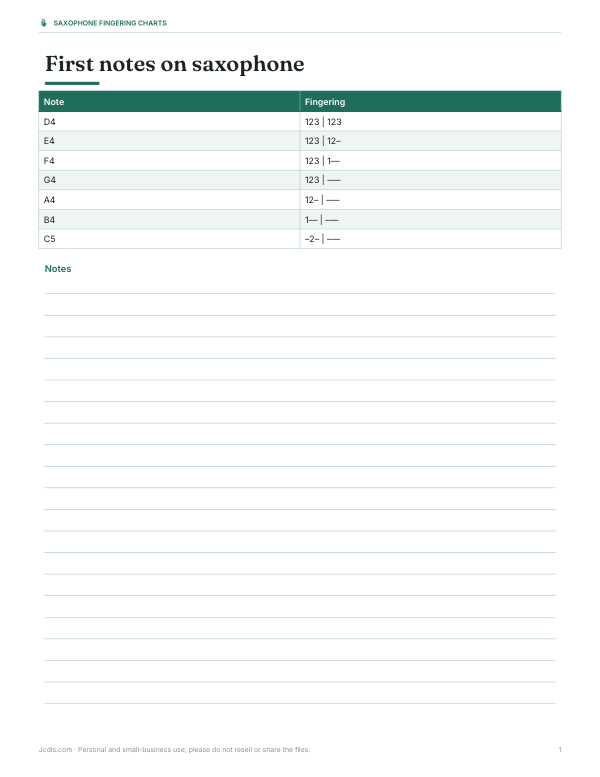
- First notes (PDF)
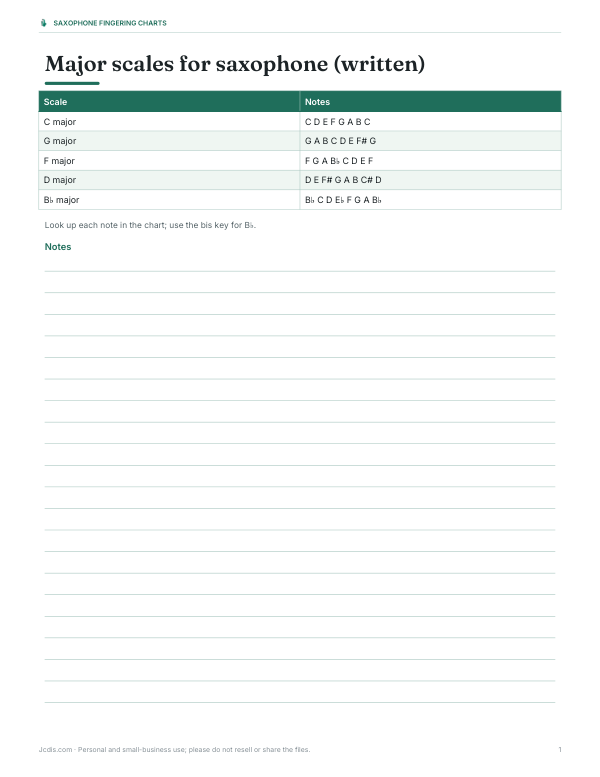
- Scale sheet (PDF)
- Practice log (PDF, XLSX)
Formats: PDF, XLSX. Instant download after payment (link valid 72 hours, up to 5 downloads). AI-assisted: the templates were drafted with AI help and reviewed and laid out before publishing.
$3.00 USD, one-time 4 files · about $0.75 each
- Instant download
- 7-day refund
- Secure checkout by Stripe
7-day money-back guarantee. Full refund within 7 days of purchase, even after you download.
Free sample: Sax Fingering Chart Full (PDF, 82 KB)
Full refund within 7 days — see the refund policy and license.
Free printables
Single sheets you can print right now, no sign-up. The full pack adds every sheet in one download plus the editable files.
 Printable Saxophone Practice Log
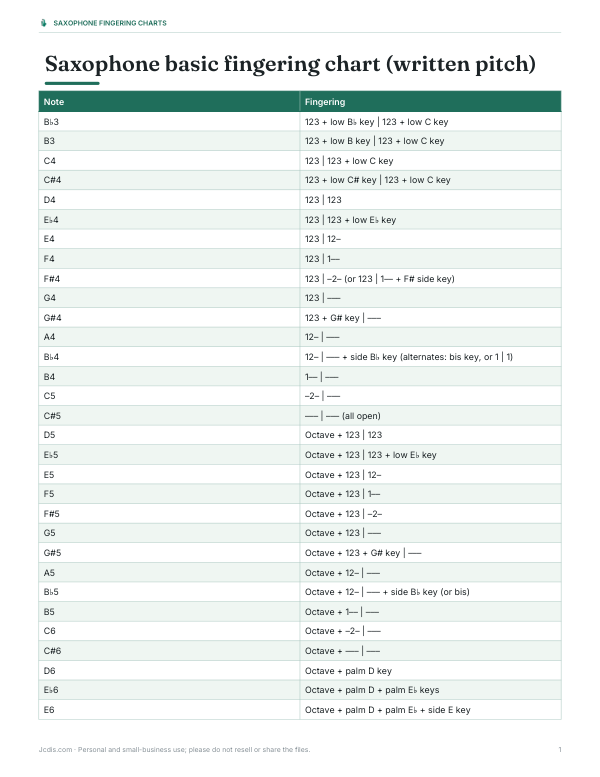
Alto saxophone fingering chart
| Written note | Basic fingering |
|---|---|
| B♭3 | 123 + low B♭ key | 123 + low C key |
| B3 | 123 + low B key | 123 + low C key |
| C4 | 123 | 123 + low C key |
| C#4 | 123 + low C# key | 123 + low C key |
| D4 | 123 | 123 |
| E♭4 | 123 | 123 + low E♭ key |
| E4 | 123 | 12– |
| F4 | 123 | 1–– |
| F#4 | 123 | –2– (or 123 | 1–– + F# side key) |
| G4 | 123 | ––– |
| G#4 | 123 + G# key | ––– |
| A4 | 12– | ––– |
| B♭4 | 12– | ––– + side B♭ key (alternates: bis key, or 1 | 1) |
| B4 | 1–– | ––– |
| C5 | –2– | ––– |
| C#5 | ––– | ––– (all open) |
| D5 | Octave + 123 | 123 |
| E♭5 | Octave + 123 | 123 + low E♭ key |
| E5 | Octave + 123 | 12– |
| F5 | Octave + 123 | 1–– |
| F#5 | Octave + 123 | –2– |
| G5 | Octave + 123 | ––– |
| G#5 | Octave + 123 + G# key | ––– |
| A5 | Octave + 12– | ––– |
| B♭5 | Octave + 12– | ––– + side B♭ key (or bis) |
| B5 | Octave + 1–– | ––– |
| C6 | Octave + –2– | ––– |
| C#6 | Octave + ––– | ––– |
| D6 | Octave + palm D key |
| E♭6 | Octave + palm D + palm E♭ keys |
| E6 | Octave + palm D + palm E♭ + side E key |
| F6 | Octave + palm D + palm E♭ + palm F + side E key |
These are the standard basic fingerings for the saxophone, as documented in references such as the Woodwind Fingering Guide. They are the same on soprano, alto, tenor and baritone saxophones — only the sounding pitch changes. Many notes also have alternate fingerings for smoother technique; your teacher may suggest others.
How the saxophone’s fingering works
The saxophone overblows at the octave, so most notes in the upper register use the same fingering as the note an octave lower plus the octave key under the left thumb. From low D upwards, lifting one finger at a time from all six down (D) raises the pitch step by step: 123|12– is E, 123|1–– is F, 123|––– is G, 12–|––– is A and 1––|––– is B. The little-finger keys add the lowest notes and E♭, and the palm keys extend the range above C#6.
Three ways to play B♭
| Fingering | When to use it |
|---|---|
| Side B♭: 12– | ––– + side B♭ key | Chromatic passages (A–B♭–B) |
| Bis key: 1 + bis | ––– | Most music in flat keys — left hand only |
| 1 and 1: 1–– | 1–– | Passages that move between B♭ and F or G♭ |
Transposition for alto sax
The alto saxophone is in E♭: a written C sounds as the E♭ a major sixth below. To read concert-pitch music (for example from a piano part), transpose up a major sixth — or down a minor third and up an octave. The finder shows the concert pitch for each written note.
How to use the finder
- Choose a written note from low B♭ to high F.
- The diagram lights up the octave, palm, side and little-finger keys used, and the main keys for each hand.
- Read the full fingering, including alternates.
- Press play to hear the concert pitch.
Worked example
Written G4 is left hand 1, 2 and 3 down with the right hand off — the note many beginners learn first. Add the octave key and the same fingering gives G5. Written B♭4 can be played three ways; in a B♭ major scale most players use the bis key, but for a chromatic run from A to B the side B♭ key is smoother.
Palm and side keys
- Palm keys (left hand D and E♭, right hand F) are pressed with the side of the hand, not the fingertips, for the notes above C#6.
- Side keys on the right hand play B♭ (side B♭), C (side C) and high E.
- Little-finger keys: left hand for low B♭, B, C# and G#; right hand for low C and E♭.
- Front F (on many saxophones) gives an alternate high F and access to altissimo notes.
Saxophone ranges by instrument
| Saxophone | Key | Written C sounds as | Typical written range |
|---|---|---|---|
| Soprano | B♭ | B♭ a major second lower | B♭3–F6 (some to high F#) |
| Alto | E♭ | E♭ a major sixth lower | B♭3–F6 (most modern altos to F#6) |
| Tenor | B♭ | B♭ a major ninth lower | B♭3–F6 (some to F#6) |
| Baritone | E♭ | E♭ an octave and a major sixth lower | A3 or B♭3–F6 |
Because the fingerings are shared, a player can switch between saxophones fairly easily; the main differences are the size of the mouthpiece and embouchure, the air needed and the weight of the instrument.
Practice tips
- Learn the left-hand notes (B, A, G) first, then add the right hand down to low D.
- Keep fingers close to the pearl buttons.
- Use long tones with a tuner to learn how each note sits.
- Practise scales slowly in two octaves to master the octave key.
- Check the pads if low notes won’t speak — a leak is often the cause.
Frequently asked questions
What is the easiest note on alto sax?
Many beginners start with B, A and G using the left hand only.
What is the fingering for middle C on alto sax?
Written C5 is the left middle finger only: –2– | –––.
What is the octave key?
The key under the left thumb that raises notes by an octave.
How do I play high F on alto sax?
Octave key with the three palm keys (D, E♭ and F) and the side E key.
Is alto sax fingering the same as tenor?
Yes — all saxophones share the same fingerings; they sound at different pitches.
What does a written C sound like on alto sax?
Concert E♭, a major sixth lower.
Is anything uploaded?
No, it runs in your browser.